
On our way home from a drive through Western Massachusetts, we drove by Erving Paper Mill, one of my early jobs. Driving by, I started remembering my first jobs and my worst jobs and the experiences I got out of my early working years. I don’t believe I had a specific title at Erving Paper Mill, but if I did, it would have been Summer Napkin Packager, Second Shift. I was 18 years old, and was working this job with my friend Kelly Charland, who had one extra year of experience on me, 1988 being her second year as a Summer Napkin Packager, Second Shift. Because of this, she got to work in the holiday napkins department. Being a new hire, I worked a floor beneath her in the white napkins department. This wasn’t my first job, and by far not my worst job – – it’s just what got me thinking about writing this story.
What did my day, or should I say night, look like at Erving Paper Mill? This was in the late 1980s, so a huge difference from what you would see now is that the break room, which had no windows and I think was actually below the ground, allowed smoking. There was a stark contrast between those of us who were just there for the summer, pretty temporary, versus the lifers, and it was pretty clear they resented us. Maybe we represented lost opportunities, or maybe summer help just highlighted the permanent nature of their employment. All I remember is being a little afraid to take the required breaks.
My shift would go like this – – and I’m sure there are now calibration methods and safety rules that didn’t exist then. Also, a machine probably does my job now. The entire shift was exactly the same – – but that’s OK, because I remember what I was being paid. $11.54 per hour, which was a solid three dollars more than any of my friends were making–no matter what they did. I would step into my shift as the person before me left me with the moving flow of plain white napkins, no break in the action. The sole function of this job was to package white napkins – – you know, the cheap kind that are wrapped in two stacks of 50 and shrink wrapped in a crinkly plastic.
Each station had three conveyor shelves of napkins, being fed through the cutter, the machine I worked on cut a 16” x 8” rectangle into two 8” squares. I had to estimate, hence my reference on calibration, approximately how many napkins would go into the entire package, so I’ll say I was to grab an 18” chunk of square napkins. I would put my right hand at the first napkin, and then reach my left hand into approximately the amount that I thought should go into the total package. The delicate nature of this work required that I squeeze this batch of napkins with precision–so that they all stayed in a bunch, but not squeeze so hard that they flew up into the air and went everywhere. That would be a crime on the paper mill floor because they’d have to stop the presses. Once I had a literal handle on how many napkins were going into the package (hundreds, thousands?, of times each shift), I would then have to carefully and quickly divide that stack in half and set it into the guard rails and hold down the set of two stacks, which would soon have a shrink wrap mechanism come down from the top to seal the packaging.
The stressful part, repeated hundreds of times each hour, was keeping my hands in it to hold the napkins down for as long as needed until the shrink wrap machine popped down from the sky and wrapped the packaging, without getting them shrinkwrapped in to the package. Then I would quickly pull my hands out and turn to my left to grab another batch of napkins as the completed package was whisked away down the conveyor belt.
In the grand scheme of things, this job really served a purpose – – to tell me why I should go to college. There were people there who had worked in the napkin rooms for 30+ years. At that time, there were no wireless headphones, or podcasts to listen to. Nor were there a lot of safety precautions. I don’t remember ever getting my hands caught in the shrink wrapper, but I’m sure it happened. I never did make it to the holiday and colored napkins department where Kelly worked, as this was a one-and-done summer job for me. I believe the next summer was when I worked at ESP Lock and Key in Leominster, assembling locks (also a one-and-done). The good news about our shift at Erving was that we didn’t have to leave for work until 2 PM, so a lot of our late mornings and early afternoons were spent floating around on rafts at the PACC in Gardner. And when there were concerts there, like The Fools, who played at the PACC in the late 1980s, Kelly and I had the funds to pay for that, and weekends off. I had so much money for school clothes that year.
A job I had before Erving Paper Mill was that I was a bus girl at the Fox Run restaurant in Phillipston. Most long-time locals probably remember the Fox Run. It was considered the local version of upscale, and it’s prime was a time before there were any chain restaurants in the area. Some local restaurant choices were the Fox Run, the King Philip, and Pete and Henry’s. My mother was a waitress at the Fox Run in the 1980s. They had very little waitress turnover, because this restaurant was always hopping, they had a lot of regulars and the tips were good. I only got my way into the Fox Run because of my mother. I pretty much had 3 functions at the Fox Run. Fold the napkins, set the tables and clear the tables. To this day, I can turn any square, cloth napkin or not, into a crown suitable for a Fox Run table setting, or a small child’s head.
My actual first job was at Lee’s Hot Dog Stand. I don’t understand how I’ve been writing these stories and there not already a story about what it was like to work at Lee’s Hot Dog Stand. I was probably 15, definitely not yet old enough to drive. It was actually also the first time I remember being yelled at by someone outside of my family! Who knew there would be a need for multitasking, speed, AND accuracy!?! I worked at Lee’s in the mid 1980s, and at that point it was owned by Ron and Al (short for Adelaide) Davidson and their daughter Twyla, who was not interested in making new friends.
On your first day, at least, you would be put on the hot dog station. Sink or swim. You must always have the correct number of napkins, ready for Al to drop a hot grilled roll for whatever number of dogs were on each order. I would listen for the cashier to yell to Al how many hot dogs on the next order. If there were no other orders in the queue, I would put that same number of napkins on the counter next to the griddle. As the orders worked their way through the queue, I’d watch for how many napkins to put down, because Al would quickly put a bun on each napkin, and then I needed to stuff those buns very quickly before she came back with the hotdog. If you weren’t fast enough, you might get the hot tongs in that sensitive spot between your thumb and forefinger. The orders were simple enough to read, once you got the hang of it. For those of you wondering who would just order eight hot dogs, they did. They absolutely did.
I learned the importance of putting relish and onions on the bottom and ketchup and mustard on top. The Works does not mean ketchup, and if an order was prepared ‘to go’, all the condiments went on the bottom. If you didn’t work fast enough to keep up with Al at the grill, you’d get sent in the back. Once you were sent out back, the options of what to do to keep busy there were limited, and never your choice. Now Ron and Al were divorced but still ran this establishment together. This is to say that sometimes you weren’t sure who to listen to, but it was always Al.
If we were sent to the back for not keeping up, Ron would either have us chop bags upon bags of onions or trim every single side of every hot dog bun with a serrated knife so they could all lay flat on the griddle after being slathered with butter. Being a teenager, I only knew what I knew, and didn’t know what I didn’t know. Straight ammonia as a cleaning agent sprayed on every surface at the end of the shift? Probably bad for our health, but boy could it get a mustard stain out. Your shift was 4 PM to 9 PM? Not a problem, just get there at 3:30 PM and you’re not leaving until after 9:30 PM, but you’re only paid from 4 to 9. Probably not legal. I worked at Lee’s for two seasons, maybe three. It felt like more. There was a lot of conflict there, and I ate a lot of fried food.
My worst job wasn’t any of these. My worst job was Weekend Nursing Home Laundry Attendant, when I was 17. My best friend Sue and I got this job at the same time, which in retrospect was kind of dumb because we alternated all the weekend shifts – – so this really cut into our 17-year-old social life. Her mother Pat was in charge of the laundry at Baldwinville Nursing Home, and had been for many years. If you need me to identify the smell of urine baked into fabric, I think I could pick that out, even during the three years after Covid when I lost my sense of smell. To this day, when I think of a nursing home, that smell comes back to me.
There were a couple of perks to this job. Even though I was making only $3.35 per hour, because there were only two washers and two dryers, I had plenty of time to read during the wash and dry cycles. Also, they had Fresca in the vending machine.
When I arrived in the morning, I would go down each hallway in the nursing home and pick up the bags of dirty laundry. We didn’t have anything magical like Oxy Clean back then, wow, that would have been a game changer. I just washed the clothes, and then sorted them by owner, because they all had their names on them, and then delivered them back to the closets in the appropriate rooms.
I got into a bit of trouble because enterprising me, at 17, realized that the earlier I went in on a weekend morning, the earlier I would get out – – because I could leave when all the laundry was finished. Also, a naïve 17-year-old me, did not think ahead as to why that was. My shift was 7 AM to 1 PM and when I started at 7 AM it would take that entire shift to complete the tasks. If I came in at 6 AM, I was usually done by about 11 AM. So me, young and stupid, but in the name of efficiency–started going in at 5:30 AM, and I was done and out by 10 AM. This was great!
The problem was the residents weren’t awake yet, so whoever did the next shift spent several weeks complaining about how heavy the workload was, meanwhile, I was getting my job done in such a short amount of time. I wasn’t always the problem solver that I am now.
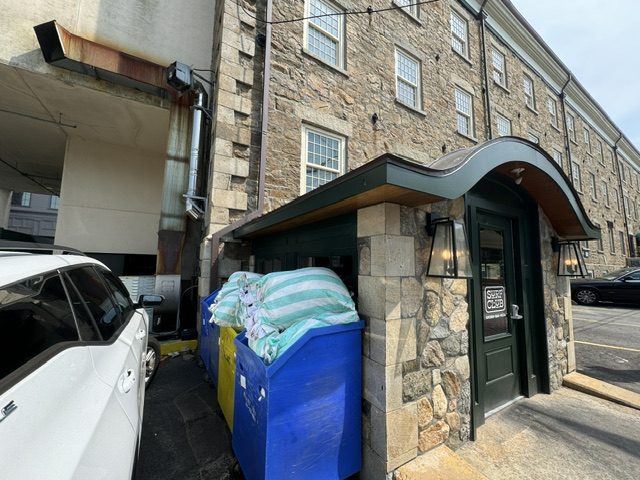
I might add to this story, but that’s enough nostalgia for now. The photo above is laundry outside of a Newport, RI hotel–and got me to thinking. I’ve had this photo on my phone for quite some time, and every time I see it, that smell comes back to me. How about you? I’m sure there are much worse jobs to be talked about.