
About 30 minutes after I got my most recent electric bill from the Princeton Municipal Light Department, I saw two different posts on Facebook from people freaked out about their own electric bills. One, within a town served by National Grid, and the other by a Princeton resident confused and distraught over the increase in her bill month over month.
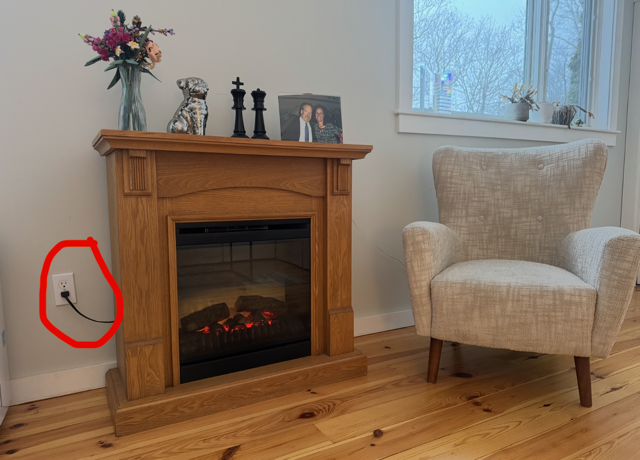
I write this as I’m sitting in my home office, next to my cute plug-in fireplace, whose only job really is to take the chill out. The fireplace is off today, has been off for quite some time and will be off for the foreseeable future. I guess it’s now just a cute decorative fireplace. I’ve seen people chime in on social media posts that they have also unplugged their second refrigerators, their backup freezers, their dehumidifiers and even someone who posted that they are not using their clothes dryer, in favor of hanging their clothes up to dry in an effort to reduce their electric bill.
I’m going to use real numbers here. We have only one air conditioning unit, which is a newer and pretty efficient Fujitsu mini-split that we put in my mother’s in-law apartment. With that A/C on only during the hottest times, our summer electric bill is usually about $375 a month. I’ve been resigned to a $450 per month approximate winter electric bill. It gets darker earlier, the heating system kicks on more, maybe people are watching more TV, the clothes we wear in layers are heavier, so the dryer is on longer, and heaven forbid you have a Christmas tree or lights outside. Then there’s all the extra cooking around the holiday, guests who you really can’t discipline for leaving lights on, the list goes on.
My February 2026 PMLD bill was $709. My house is large and we have an in-law apartment. I don’t expect a small electric bill, but I also didn’t expect $709. The first thing I looked at was the number of days in the billing cycle and in this case, there were 29 days in the January billing cycle, and 35 days in the February billing cycle. Now, how could that be with February being the shortest month of the year? I emailed PMLD customer service–not really questioning the number of days in the billing cycle being more than there were days in the month, but just in general to try to get a handle on why my usage year-over-year had such a discrepancy. Oversharing here, but my February 2025 usage was 2,100 kWh and my 2026 February usage jumped to 2,820 kWh. Comparing billing cycle length, they were 34 and 35 days, so the mystery is why such a drastic increase in usage from one February to the next February?
To add confusion to my own situation, we had a wood-burning insert installed in December 2025. The unit we chose actually had a $2,000 tax credit because of how efficient it is. There is a fan that will kick on to blow the heat further out in to the room, and that fan is on a fair amount. But I’ve also noticed the furnace doesn’t kick on as much, so I’m thinking that should be some kind of trade-off.
*Note to anyone considering using a supplemental heat source like a pellet or wood stove to avoid having your heating system kick on–be CAREFUL to not freeze your pipes. We used to do that occasionally when we lived in Westminster. The woodstove was so cozy that we’d let it keep the house nice and toasty, and then next thing we knew we had a frozen pipe somewhere. Here, we have a forced hot air system, so the risk is less as long as the basement is kept at a reasonable ambient temperature.
I talked with Karen at PMLD, who is very helpful, but as nice as she is, she’s certainly not in a position to give me a discount just because I’m also nice. It was a nice conversation, and I learned a few things. For starters, I didn’t know that our electric meters have a digital readout on them. Anytime I’m near the electric meter, it’s because I’m picking raspberries, not looking at the meter. She suggested going outside and looking at the meter to see how many kilowatts I’m using at any given time and then going inside and unplugging an appliance or other electric item, and then going back outside to the meter to see how that literally moves the meter. I’m accustomed to just seeing that little spinning dial, and did not know there was a different way to see what you’re using in real-time. This sounds like a job for Jay.
Another thing she suggested was a Kill-A-Watt device. Well, good thing I didn’t declutter it as part of my whole house decluttering, but I have a Kill-A-Watt meter somewhere around here from when Jay and I used to write the Vine, our very popular Westminster newsletter back in the mid 2000s. I’ll update this story if/when I find it, in case someone wants to borrow it. Basically you plug it in to a wall outlet (will not work for your kitchen stove or electric clothes dryer) and then plug the potentially offending appliance into the Kill-A-Watt device and you will learn what that energy usage is. I’m sure in my house the black-and-white answers will be “it is what it is” and “it all adds up”. I’ve tried the “if it is to be, it is up to me“, but apparently not everyone appreciates my aggressive turning off of lights.
We obviously have a refrigerator in our kitchen, but then we have a backup refrigerator in our pantry. My mother also has a full-size refrigerator in her accessory apartment and we have a backup chest freezer in the basement. All of those are seven years old or newer, and all allege to be Energy Star. We have two washer and dryer set ups with five people living in the house. We also have a small beverage refrigerator and a dorm style refrigerator in the family room – – I’m going to check both of those little fridges because I wonder how inefficient they are, being that they are much older.
I learned from PMLD that they have a Kill-A-Watt device that can be borrowed by PMLD customers with electric bills. They require a $50 check as a deposit when you borrow the device, but they will only cash the check if you don’t bring it back – – so they can replace it. That makes sense. She also said they have the device available for borrowing from the Princeton Public Library!
If you are a National Grid customer, they have a budget plan that allows for bill payers to equalize their electric bills by paying their average monthly bill year-round. They also have a program where they have a no-cost pick up and removal service AND they will pay you $75 to take your old inefficient refrigerator away (assuming you will have replaced it with something more efficient). Here’s a video about the budget plan. Sign up for National Grid budget billing here.
Here are some questions I came up with to ask yourself when trying to solve the mystery of a spike in electric usage. The reason I did this is BECAUSE when I really thought month by month about the changes in our habits, I realized that our college-aged daughter graduated in 2025 and we’ve got a full extra person here. One who changes her clothes constantly (washer/dryer), cooks a ton (propane for cooking, but then there’s the dishwashers on duty more), takes long showers, she seems to style her hair a lot, and isn’t exactly a rockstar at shutting off lights. That could account for a good amount of my February 2025 vs. February 2026 increase.
- Have you had more people in the house than usual — kids home from college, holiday guests, or a family member who moved in or visited for an extended period?
- Did you add any new appliances, devices, or electronics since last year, even something that seems small like a gaming console, space heater, or extra TV?
- Are there any appliances that run continuously — refrigerators, freezers, dehumidifiers, sump pumps — that might be aging and working harder than they used to in order to maintain their temperature or function?
- Did you change your habits around heat? For example, are you relying more on electric space heaters to supplement (or replace) your main heating system? *These things cause fires when used improperly. See here about our deep dive on our own homeowners insurance policy.
- Have you added any kind of plug-in comfort item this year that runs for long stretches — an electric blanket, heated mattress pad, plug-in fireplace, or heated throw?
- Did your holiday decorating go bigger this year — more lights inside or outside, or lights left on longer than in prior years?
- Are college-age or teenage kids in the house more this year, and if so, are they charging more devices, gaming more, or keeping different (later) hours that keep lights and screens on longer?
- Has anything changed with your hot water usage — more people showering, a new dishwasher cycle habit, or a hot water heater that might be struggling?
- Did you get any new outdoor equipment that plugs in — a car charger, outdoor lighting, a hot tub, or holiday inflatables with fans?
- Is there anything running in a garage, basement, or outbuilding that you might not think about day to day — a workshop heater, an old extra freezer, a dehumidifier left on from summer, or grow lights?
- Have you changed your laundry habits — more loads, hotter water settings, or longer dryer cycles because of heavier winter clothing?
- Could there be something running that you’ve simply forgotten about — an old mini fridge in a guest room, a fish tank heater, or a treadmill with a standby mode that draws power constantly? *Hmmm, will have to check that treadmill.
Something else to consider is an energy audit. I wrote the story below, which is now the second half of this story, a few years ago, and never published it until now. I hope you get something useful out of it. Meanwhile, I’ll be eating ramen noodles over here as I take a bite out of that $709 electric bill.
Looking for a way to get a handle on (and possibly tame!) your utility bills? Anytime I’m attending a home inspection, the home inspector will mention that the house would benefit from a Mass Save energy audit or home energy assessment. Mass Save is “a public-private partnership between Massachusetts’ investor-owned utility/energy providers (such as Unitil, Eversource, and National Grid) and the state’s Department of Energy Resources. It is funded by ratepayers via an energy-efficiency fee on utility bills, offering rebates and services to residents and businesses.” –Google
Never fear Ashburnham, Holden, Princeton, Templeton and towns served by municipal electric utilities, there’s a program for you, too! *Contact me if you need the link to getting an energy assessment in your town.
My experience with energy audits started in our inefficient 1790 brick farmhouse in Westminster. I was painfully aware of the need for proper weatherproofing, one example being that the curtains moved when the wind blew. I made the appointment for my Mass Save energy audit, and while the auditor was on site, he switched out every single lightbulb, including in bedside lamps, at no charge. I also got weatherstripping for no charge and significant discounts on insulation, if I chose to go that route.
A few years later, we were living with my parents in Templeton and planning to sell their house once we found our own new home, I looked into getting an energy audit, and learned that the local towns with municipal electricity had a different program. I was a little disappointed at the time, back in 2015, to be given a sample lightbulb and a book on energy conservation.
When we moved to Princeton, it took a while to get used to the house and all its systems. About three years in, and sick of big electric bills, I thought about getting an energy audit, but it was during Covid and they weren’t doing in-person energy audits, just virtual. If you’ve ever been in my house, you know it’s way too confusing for a virtual energy audit. We have a drive under garage that is accessed by a set of stairs, not readily visible, and we lived here for three days before Jay admitted that he couldn’t find his car. That is a true story. Well, my parents were cold and asked about having more insulation installed, and maybe some air sealing.
I looked on the local energy efficiency website and wanted to take advantage of some of the programs available to Princeton homeowners. Alas, in order to benefit from the rebates, I needed an energy audit to fall back on. Apparently that damn virtual energy audit was the first step. I went into it thinking this is the dumbest thing ever. Because it was during Covid, I had to schedule several months out, and then I needed to walk around the house on FaceTime with the energy auditor (who it turns out I sold a house to her sister).
She asked a million questions and then would have me go back and revisit an area and show it to her relative to other locations in the house (what’s above that room?, what’s underneath that room?, what direction do those windows face?, etc.). I don’t remember how long it took to get the actual audit back, but I was shocked at how accurate it was.
I contacted a Mass Save contractor, and arranged for air sealing and insulation to be done on the north side of the house, which is the area where our Inlaw apartment is. The house is large, so projects are often undertaken in an area but not the whole house. This works well with the energy savings initiative, because there are maximum rebate benefits each year. My memory might be a little inaccurate but I think that year they had a 50% rebate up to $1,000 ($2,000 in projects got me a $1,000 rebate). Then the next year I checked in to see what they were assisting with and had that work done as well, and hit the maximum of what the rebates allowed.
What else have you come up with that I can add to this story? Or how about what contractors would you recommend for energy improvements that have a connection to the Mass Save program? Use the contact form below to enlighten me!