
I’ve seen too many adult kids– –who are now in their 50s, 60s and 70s, stuck with the daunting and often overwhelming task of emptying decades of accumulated stuff in a house they haven’t lived in for many years. I’ve seen it over and over again–people tend to let their homes fill up, sometimes to a point where there’s literally no room to move. I even know of one local family where the house has just been handed down or purchased by the next generation – – since it was built in 1800, and every generation’s stuff is still in the attic.
To be fair, there’s a big difference between having too much stuff, being a packrat, and outright hoarding. I’ve respectfully worked with sellers who fit in to all of those categories, as well as people my age and much older having to go through houses that their parents never even began to weed through what they have.
I’m going to go through my own house in a series of stories, sharing some areas that need attention and implementing solutions that will help me reduce and repurpose a wide variety of things. I’ll have to be selective about showing too much under the hood, since I don’t want people thinking I’m a disorganized mess! Unless you’re a minimalist, either by nature or nurture, you can probably relate to the frustration of having just too much stuff.
Jay has a theory that because many of our parents or grandparents lived through the Great Depression, or were raised by someone who did– of a lot of us won’t discard no-longer-worn shoes (just one example of many!) because what if they were all you had and you needed to use them again? I’m trying to work that out of my system, but I’m absolutely guilty of saving things that really should go.
Here’s a perfect example. Since I graduated college in 1992 my mother had been asking me to go up to her easily-accessible well-lit walk up attic and go through some of my old things, including college textbooks. Well, the joke was on me 24 years later in 2016 when my parents were moving in with us and there I was in her very full attic– –going through my college textbooks. At a time in my life when I had a million other things to do being that I had just moved and was now moving my parents in with us.
When it comes time (that’s one way to say it), I don’t want my kids to have to take months (or even years–I’ve seen it) weeding through all the accumulated items and collections, and I sure don’t want them to have to deal with random stuff that maybe the generation before me should’ve made a decision on.
Don’t worry–I’ll still leave them with challenges. They’re definitely going to be scratching their heads with things like “What do we do with these 4 dollhouses and all of this miniature furniture and decor?” Or “Great, 1000+ record albums”. I also don’t want them to be fighting over a specific necklace or painting, but that’s a different topic for another story.
Over the next several months, and it could actually stretch into next year or even further, but all in the name of forward progress – – I’m going to visit certain areas of my house and make a real attempt to pare down the most obvious things that we no longer use, and that I don’t think the kids will ever want.
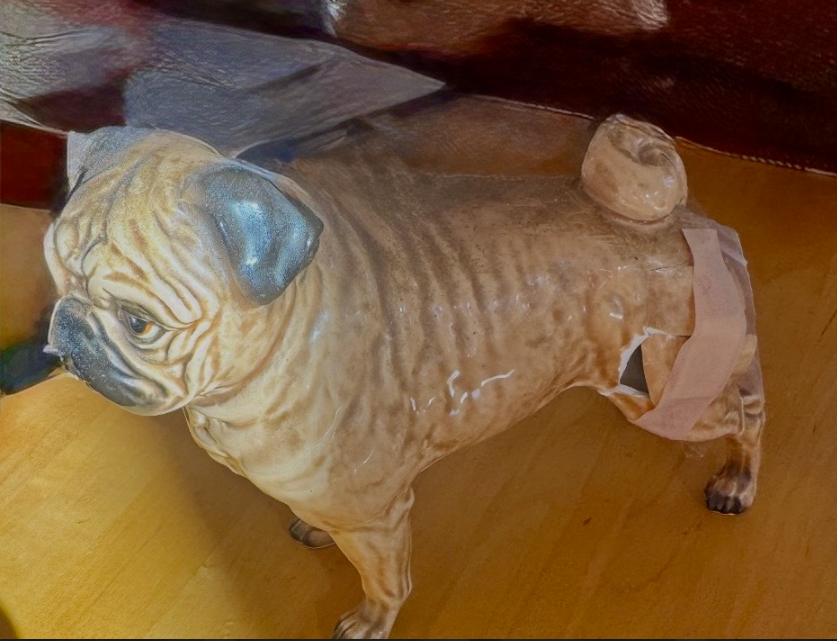
I’m going to start with the low hanging fruit. For instance, this little ceramic pug statue pictured above. It’s old, and to the collector of all things pug, it’s old enough to be probably rare. If it came up at an auction, someone would buy it either as a joke or because they love pugs. But here’s the thing: This pug statue fell off of our mantel at some point, and my mother was kind enough to glue and tape it back together. It was funny for a while, but I don’t envision that 40 years from now my 65+ year-old children would do anything other than laugh (at me, for keeping it), possibly remember one thing about it, and then throw it away.
As part of this process, I’m also going to make it easy on people to repurpose items that they’re willing to let go of, but they may have an emotional connection to, or they just don’t want to throw away something that may be useful to someone else.
Each story will come with a list of resources to help reduce, repurpose and recycle that particular category of items. I’ll use the word ‘discard’ to mean whatever it means to you—based on the condition, the time you have available and your general tendencies. An example—imagine you’re emptying someone’s house with your family members…up for discussion is a ___________. *Fill in the blank with ‘set of dishes’, ‘box of costume jewelry’, ‘pile of jigsaw puzzles’ or ‘good quality empty box’. In your cohort you may have one person who says ‘send it to the dumpster’, another says ‘let’s donate that’ one who wants to sell it locally or online, and yet another who says ‘but that’s a good empty box’. That’s all just to say that the word ‘discard’ can mean any of those things. I just use discard to mean get it out of your house and never see it again.
I tend to be a keeper, so I don’t actually discard much. I’m working on it. The truth is the larger your space, the easier it is to keep things you don’t need. But as an example–yesterday I was cleaning my garage to make room to actually be able to fit the vehicle inside before a snow storm. I came across a solid wood door from a recent project, and a new household steamer. I would never throw those things away, and I’m not going to take the time to list them for sale anywhere. So, my most likely path of discarding these types of things is to find a person or organization who will take them off my hands, preference given to someone who will pick it up ASAP. Sometimes I’ll put things free at the end of the driveway, and I also bring a lot of reusable items to our regional recycle center. Don’t miss my related stories:
Municipal Trash and Recycling in Central Massachusetts Cities and Towns
Thrift, Consignment and Vintage Clothing Shops in Central Mass
Home Decor and Antiques Consignment Shops in Central Mass
Where do you want to start in your home?
SPORTS EQUIPMENT
Let me tell you about the very much already decluttered and reduced sporting goods area of our basement. It can stand another round of attention. This area takes up about 16 square feet, so not a lot of room, but we’re never going to be lacrosse players again—and in fact, I don’t know why we have any lacrosse equipment, since no one in our family has ever played lacrosse.
Every once in a while, one of the kids – – the youngest is mid-20s, needs a pair of ice skates, or even the occasional hockey stick for some casual hockey on Wyman Pond. But, we also have three sets of golf clubs, and I truly don’t think anyone in our family has ever played golf. I don’t mean on a regular basis, I mean ever. Now, who knows what the future might bring – – so I think it’s reasonable to keep one set of golf clubs.
Sports Gear: Resale and Donation Options
I was recently inspired by my friend Joe Lovett to go through our golf items collection because Joe, who is involved with a foundation named It’s A Calling, that partners with PGA Reach, which is the 501(c)(3) charitable foundation of the PGA of America. As part of a spring 2026 initiative called Sets Fore Vets, Joe and his wife, Jen, friends of ours and owners of 16 Liberty Tax office franchise locations, which are designated drop spots for gently used golf equipment to be donated to Sets Fore Vets. More info here about the It’s A Calling Foundation and Sets Fore Vets in this accompanying story: Sets Fore Vets: Got Newer Golf Equipment to Donate?
My assortment of golf equipment is older, so it won’t likely meet the criteria for Sets Fore Vets. However, there are plenty of other resale and donation opportunities for sporting goods and equipment in my story link above.