
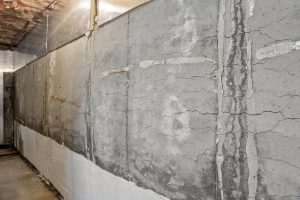
I’ve been following a major issue–crumbling concrete foundations in Massachusetts, for about a year now, and it’s very surprising to me how many people have STILL never heard of it! Some people know a little bit about it, and some people just have bad information that they’re sharing as if it were fact.
The good news is that finally, after 8 years of grassroots awareness-building by the folks at Massachusetts Residents Against Crumbling Foundations, and the legislators who have supported their efforts–there is an appointed working group charged with making recommendations for dealing with this natural disaster that is spreading further and further throughout Massachusetts, far from its original known source in Connecticut.
This is the fourth story I’ve written about this natural disaster currently unfolding in Massachusetts. The issue is that pyrrhotite, a mineral aggregate used in concrete foundations, has proven to be destructive over the course of 10, 20 and 30 years after the foundations were poured. What we now know wasn’t known before–to homeowners, builders, concrete companies–and it’s absolutely destructive and financially terrifying to those affected (and we are all affected…continue reading).
I have three friends who have crumbling foundations. That sounds scarier than it actually is—they are my friends because I met them through Massachusetts Residents Against Crumbling Concrete Foundations. Their stories are all different, and they live in 3 different communities, 3 of the 49 cities and towns in Massachusetts that have had at least one home with an unfixable crumbling foundation. The Massachusetts Residents Against Crumbling Concrete Foundations website is maintained by affected homeowners as a resource for other affected homeowners. UPDATE 1/10/2026: Hudson and Marlborough were just added, so we are now at 51 cities and towns with at least one affected foundation.
When I started writing this story, it was intended to just be a Myth vs. Fact list (because there are so many armchair ‘experts’ who spout off laughably incorrect information on their social media), but the story has evolved to be more than that, and includes validating research, resources and a status of where the issue now sits at the state level. I like to be a source to another source, so you’ll see plenty of links throughout the story. I’ll include some Myth vs. Fact and resources for you if you want to dig deeper AND what to do if you think your foundation might be affected.
First, what do I mean this is a natural disaster? At a 2025 session at the State House, two people who spoke about crumbling concrete foundations in Massachusetts referenced it as a ‘natural disaster’–in part because it’s caused by a mineral in the concrete aggregate, no person caused it, no contractor took a shortcut route to cause it–it was just a bad mix and nature took over with water and oxygen. That’s the ‘natural’ part of it. The ‘disaster’ of it is how financially and emotionally ruinous it is to affected homeowners.
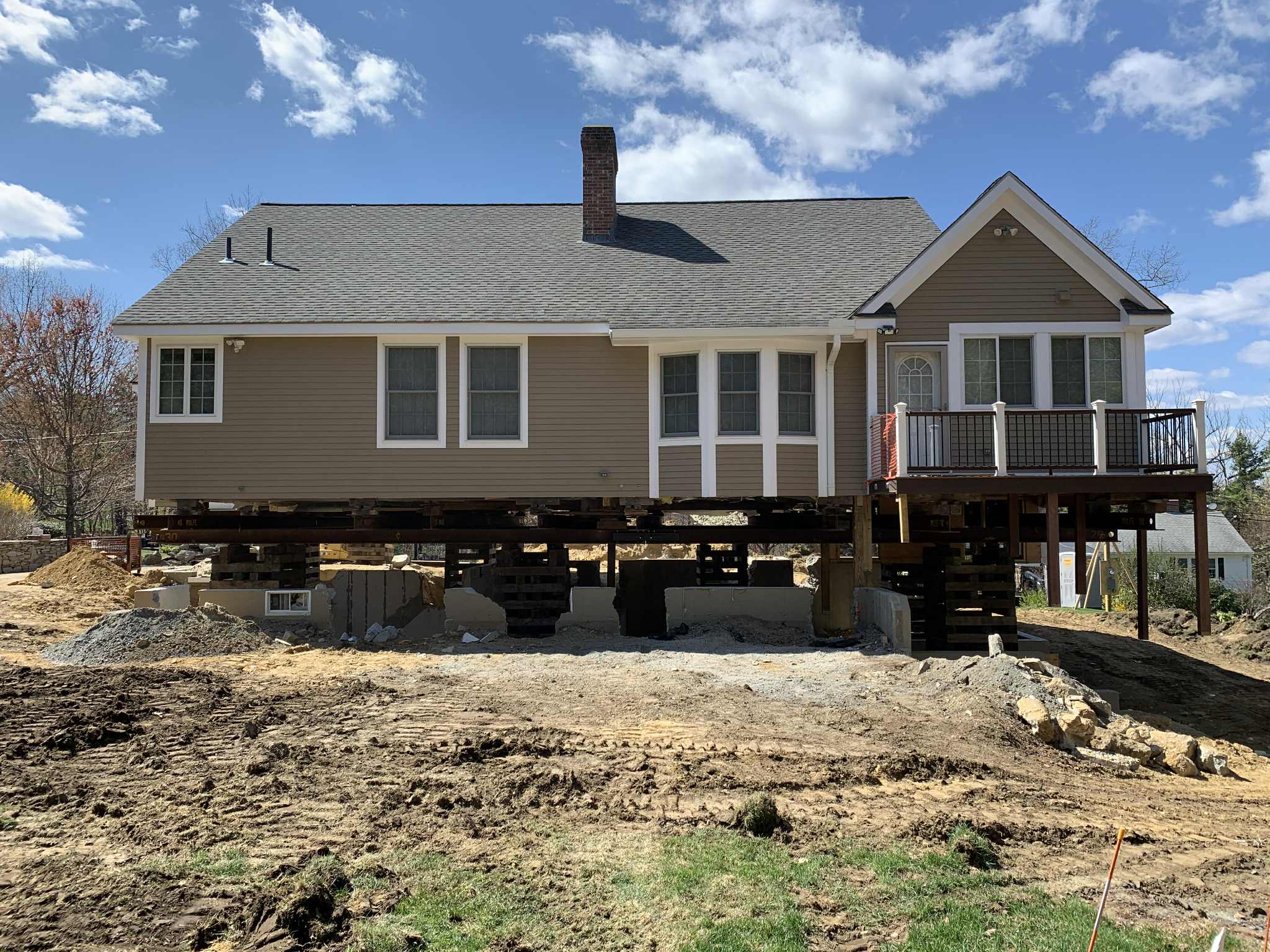
Imagine you’re nearing retirement. You’ve done everything right, saved and started to think about the future. Surprise, your foundation is crumbling. Insurance doesn’t cover it, and the only way to fix it is to lift the house, and replace the foundation. Pictured above, the first house in Holden.
You built your family home, and because you knew there were wetlands nearby, you went above what was required at the time and put extra drainage and perimeter drains. Just when you’re nearing retirement and doing the math to be able to sell your home to your son, you find this weird cracking on your foundation walls and ask the internet what these cracks are. 8 years later, with no relief from the state or insurance company, you’re still living in a house that will eventually have more structural damage than can be fixed. This is the first house in Monson.
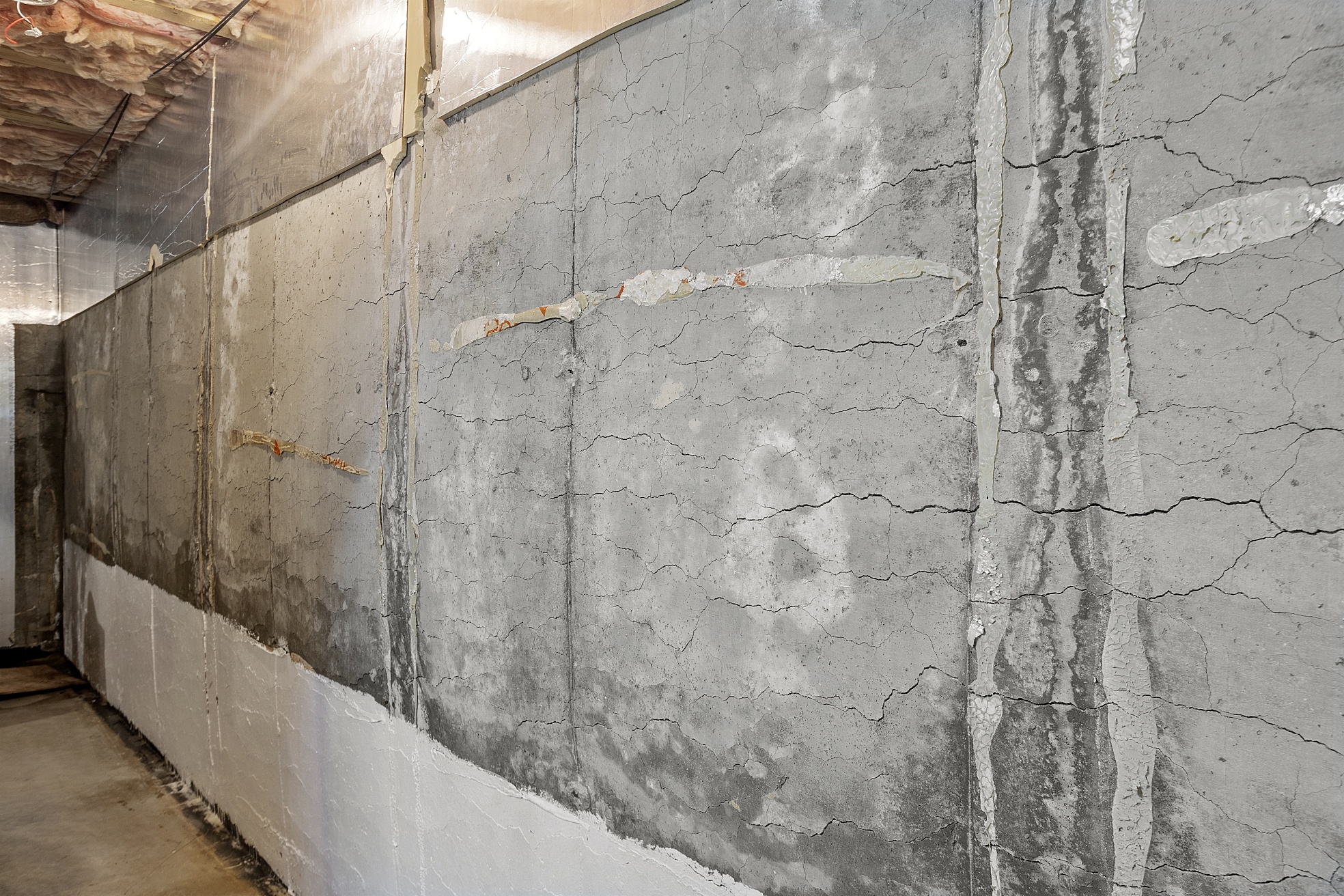
Imagine you’re the personal representative of a very modest estate, which includes a small house. While working to settle the estate, you find a newspaper story in your family member’s home, and evidence that your family member tried all kinds of potential solutions–none of which worked. The high water table on the property has exacerbated the problem and the foundation cracks exposed to significant moisture are affecting the structural integrity of the house. This was my first listing with a crumbling concrete foundation, and the house sold for approximately half of what it would have if not for pyrrhotite.
I even have a new friend in Princeton who had their house for sale, never having heard of pyrrhotite. A home inspection revealed a potential issue with the concrete walls, and further research confirmed. No bank will lend on this, so they scrapped plans for the foreseeable future and can’t make a move.
What is Pyrrhotite?
“Pyrrhotite (PEER-o-tight) is a naturally occurring iron sulfide mineral that is often found in marine sedimentary rocks. It can also can be found in some igneous rocks and some metamorphic rocks that are of a marine origin. It is a highly reactive mineral and breaks down in the presence of water and air. Pyrrhotite, even at low concentrations in concrete aggregate, is responsible for the premature crumbling of many concrete basements in northeastern Connecticut and south-central Massachusetts.” –Trinity Concrete Analysis, Trinity College
How does Pyrrhotite cause all this damage?
“When the highly reactive iron sulfide encounters water and oxygen, it transforms into sulfate minerals — ettringite, thaumasite, and gypsum — that occupy more space than the pyrrhotite they’re replacing. This expansion in volume pressures the surrounding mix of aggregate, cement, and water in concrete, forcing it to crack. This phenomenon is called an internal sulfate attack. For a long time, the attack happens under the surface and can take anywhere from 10 to 30 years for cracks to appear. But once the splintering starts, Wille explained, the concrete’s degradation accelerates, as the fissures expose pyrrhotite to more moisture and oxygen.” –Benjamin Cassidy article on Pyrrhotite and foundation issues in Massachusetts, Canada and Ireland
MYTH: My foundation looks fine, so this doesn’t affect me.
FACT: Pyrrhotite is everyone’s problem, and it will affect you one way or another.
There are now 51 cities and towns in Massachusetts identified to have at least one affected home. With 351 cities and towns in Massachusetts, that puts the count at about 14% of towns in Massachusetts have at least one home with an unfixable foundation, resulting in a house that has significantly diminished value. Why is it everyone’s problem if there’s just 1, 5 or 10 homes in an affected town? Well, as a tiny bit of relief for these homeowners, some towns now have tax abatement standards for homeowners with a crumbling foundation. Every municipality has a budget to fund, and when some properties have a reduced value, the assessed value is lower (see ascribed depreciation schedule below). When your fellow municipal taxpayer has a reduction in their real estate tax bill, that shortfall must be made up by all the other taxpayers to fund the municipal budget. This can have a huge financial impact on the fiscal stability of small towns as more homeowners come forward. This is why the state needs to come up with a solution, with many people suggesting something modeled after Connecticut’s successful program for assisting homeowners.
“The Rutland Board of Assessors voted unanimously at their meeting on November 19, 2024 to revise the Crumbling Foundation Policy in order to follow a standard protocol for consistency for all taxpayers who have a crumbling foundation issue due to the presence of pyrrhotite. In order to be consistent for all taxpayers who have crumbling foundations due to the presence of pyrrhotite, the board has updated the following depreciation schedule, as a result of home sales identified as having crumbling foundation to establish market data:
• Level A (documented to be “defective”- no sign of problem), 20% (requires a petrographic analysis to establish the problem actually exists)
• Level B (minor degradation-minimal repairs required), 35%
• Level C (minor to moderate degradation-moderate repairs required), 60%
• Level D (moderate to severe degradation-significant repairs required), 75%
• Level E (severe degradation-imminent threat of failure), 100%
This depreciation will be applied to the building value. This assessment will be valid for five years but the homeowner and/or assessor may request a re-assessment based on changes or advancement of the problem. The Board of Assessors will re-evaluate the five-year period if or when more information to remediate becomes available.” –Rutland MA Board of Assessors
Rutland Crumbling Foundation Application
MYTH: This is a Connecticut problem.
FACT: This is also a Massachusetts problem, creeping further east and north to the New Hampshire border.
What started in 2017 as a “Connecticut and Western Massachusetts issue” has grown to affect now 51 cities and towns in Massachusetts so far! Connecticut can identify just ONE quarry in Willington, Connecticut, which was closed in 2015. In Massachusetts, tests of concrete from some affected homes show three different sources as of 2025, and there are more than 150 quarries in Massachusetts. It has been scientifically proven through geological testing that MA has 3 ADDITIONAL SOURCES besides the original Connecticut source.
FEMA Case Study: Connecticut’s Crumbling Concrete
Getting Reimbursed for Testing in Massachusetts
Have you had a professional visual inspection or core testing done on your foundation? Here are the details on the testing reimbursement program (including the actual application).
You’ve had the visual inspection or core testing done on your home in Massachusetts, and now what? If your results came back negative, that’s a huge win for you. If your results show pyrrhotite, there’s not yet a financial solution other than funding the entire thing yourself. This costs hundreds of thousands of dollars per home.
If you think you have a crumbling foundation due to pyrrhotite please reach out to either Michelle Loglisci or Karen Riani at Massachusetts Residents Against Crumbling Foundations. This grassroots organization is an incredible resource for affected homeowners. They track affected homes by town, and the dates they were built. Knowing where the affected homes are provides them with data to understand the scope of this horrendous issue in Massachusetts and to share the information with legislators and the Massachusetts Crumbling Concrete Stakeholder Working Group.
The Secretary of Housing and Livable Communities has appointed a Crumbling Concrete Stakeholder Working Group. The working group report is due in March, 2026. The group will be making recommendations to the legislature related to prevention and remediation.
“We are just a group of homeowners affected by this horrendous issue. This is an emotional and financial nightmare to live through. We will continue to advocate until the state has a program similar to Connecticut. We don’t need to understand what pyrrhotite is, we need to know what we’re going to do as a state.” –Karen Riani, Holden
What is the Crumbling Concrete Stakeholder Working Group?
“The secretary of housing and livable communities shall convene a stakeholder working group to make recommendations for any regulatory and legislative changes necessary to comprehensively address the remediation of residential property foundations that have deteriorated due to the presence of pyrite or pyrrhotite. The working group shall include: the secretary of housing and livable communities or a designee who shall serve as chair; the secretary of transportation or a designee; the undersecretary of consumer affairs and business regulation or a designee; the commissioner of insurance or a designee; the commissioner of banks or a designee; 2 members appointed by the attorney general who shall have experience in advocating for homeowners and consumers; the house and senate chairs and house and senate ranking minority members of the joint committee on financial services; 2 representatives of the Massachusetts Residents Against Crumbling Foundations; a representative of the Massachusetts Concrete & Aggregate Producers Association, Inc; a representative of the Massachusetts Municipal Association, Inc.; a representative of the Massachusetts Insurance Federation, Inc.; and a representative of the Massachusetts Mortgage Bankers Association, Inc.
The working group shall examine: (i) which executive office, department, agency or bureau within an executive office, if any, is best equipped to administer a program to assist residential property owners impacted by the presence of pyrite or pyrrhotite or which executive office or department is best equipped to oversee a new agency or bureau; (ii) relevant models to assist impacted homeowners including, but not limited to, a captive insurance company, a supplemental loan program, an interstate agreement with a captive insurance company with expertise in assessing residential property foundation claims, property tax abatement and waiving local and state permit fees; (iii) models to assist impacted homeowners including, but not limited to: (A) insurance surcharges on certain homeowners’ insurance policies which shall not exceed $12 annually and when and on which policies the surcharge would apply; and (B) other sources of state and federal funding opportunities; and (iv) methods to improve consumer protection through means including disclosures, appointment of a homeowner advocate within a department, agency or bureau to assist impacted homeowners and consumer education.
The working group shall submit its report and any recommendations to the clerks of the senate and house of representatives, the joint committee on environment and natural resources, the joint committee on housing and the senate and house committees on ways and means not later than March 31, 2026.” –Charge of Crumbling Concrete Stakeholder Working Group and list of appointees.
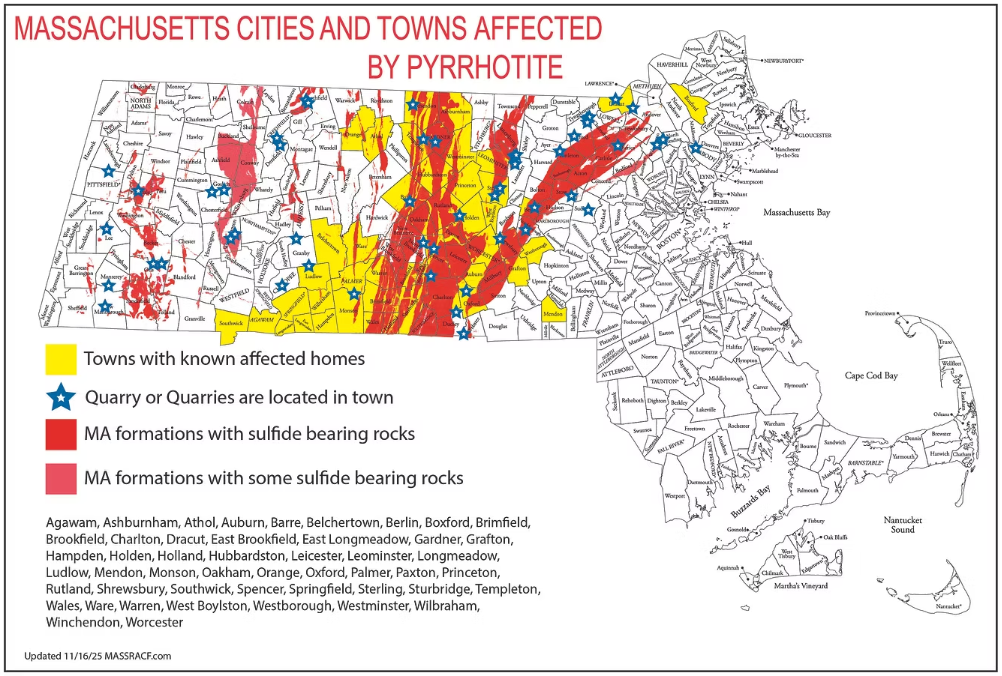
The map below lists towns that have been identified as impacted by the presence of pyrrhotite, as of November 2025. Six towns have been added since September 2025.
Follow this and you’ll see the potential for hundreds, if not thousands, of homes in Massachusetts to be eventually found as affected. The blue stars are where quarries can be found. The red area is where the mineral causing the problem can be found because the geology is right to contain pyrrhotite. The yellow highlighted towns have at least one confirmed affected home.
Agawam
Ashburnham
Athol
Auburn
Barre
Belchertown
Berlin
Boxford
Brimfield
Brookfield
Charlton
Dracut
East Brookfield
East Longmeadow
Gardner
Grafton
Hampden
Holden
Holland
Hubbardston
Hudson
Leicester
Leominster
Longmeadow
Ludlow
Marlborough
Mendon
Monson
Oakham
Orange
Oxford
Palmer
Paxton
Princeton
Rutland
Shrewsbury
Southwick
Spencer
Springfield
Sterling
Sturbridge
Templeton
Wales
Ware
Warren
West Boylston
Westborough
Westminster
Wilbraham
Winchendon
Worcester
A few social media comments:
Make a homeowners insurance claim and hope they don’t cancel you.
WRONG–crumbling foundations are not covered by homeowners insurance in Massachusetts.
Build a block foundation on the existing footing inside the home–not the most attractive but it will save the home without having to jack up and remove old foundation.
WRONG– you can’t fix this with a sister wall. It doesn’t stop the existing foundation from cracking and as it cracks it pushes up on the structure. Before you know it, windows and doors don’t open or close properly, drywall starts to crack and floors begin to buckle.
This one is my favorite: “I’ve been in Central Massachusetts for over 75 years and I’ve never seen any foundations that look bad”, to which another Facebook user responded “I’ve been on the planet for 40 years, never seen the Arctic, must not exist then, according to your perception of the issue.” Sometimes you’ve got to find a little humor.
FAQ
Here are some questions I’ve seen online and some resources for finding answers.
Q. What years of construction are an issue?
In Connecticut, the affected homes fall between the years of 1983-2015. Massachusetts homes are affected by other quarry sources, currently dating 1985+. Massachusetts quarry testing requirements began in November 2025.
Q. How many houses are affected in Massachusetts?
This number is not officially known, but will become clearer as more people come forward. There is a new law around home inspections in Massachusetts (effective October 2025), which is resulting in more home inspections. More home inspections means more professionals going in basements looking for any signs. A general home inspector is likely to highlight any readily visible areas of potential concern, and I’ve heard them suggest further investigation. The people at Massachusetts Residents Against Crumbling Foundations are appreciative of the home inspectors who are knowledgeable about pyrrhotite and have identified these affected homes during inspections, and are further extremely grateful for those homeowners who have then moved forward with testing for confirmation.
Q. I think our house has this issue but was built in the 1950s.
A. A house built in the 1950s is unlikely to have a pyrrhotite issue. Plus, the damage would already be extensive. It takes about 10 to 30 yrs for pyrrhotite to cause visible damage – cracks etc. Damage to a 75+ year old foundation is unlikely to be caused by pyrrhotite. But if you want to know for sure, you could have it inspected by a structural engineer, and apply for reimbursement through the state.
Q. Who do I contact to have my foundation tested?
A. There is a list of contractors on the Massachusetts Residents Against Crumbling Foundations website. As always, do your own research and due diligence before hiring anyone.
Q. So what’s the solution?
A. The only safe and effective remedy is time consuming, life-disrupting and incredibly expensive. They lift the house off the foundation, remove the old concrete and pour a new foundation with concrete that doesn’t contain pyrrhotite in the aggregate.
Q. My house was built as part of a whole development, and I’m pretty sure the concrete came from a local source but haven’t been able to confirm this. How do I find out what houses were affected in a specific town in Massachusetts?
A. There are no records of where concrete comes from on building department records, and there’s no way to know without inspection/core testing.
Q. Can I get financing or assistance in replacing my affected foundation?
A. There are no financing options at this time. Massachusetts Residents Against Crumbling Foundations has been advocating for 8 years for Massachusetts to provide a program similar to what exists in Connecticut.
Q. How can I find out more?
Visit the Massachusetts Residents Against Crumbling Foundations website and follow their Facebook page.
If you think you have a crumbling foundation due to pyrrhotite please reach out to either Michelle Loglisci or Karen Riani at Massachusetts Residents Against Crumbling Foundations. This grassroots organization tracks affected homes by town, and the dates the affected homes were built. Knowing where the affected homes are provides them with data to understand the scope of this horrendous issue in Massachusetts and to share the information with legislators and the Massachusetts Crumbling Concrete Stakeholder Working Group.
Connecticut Foundation Solutions Indemnity Corporation, Inc.
SEPTEMBER 2024 Original Story
Pyrrhotite: The Scariest Word in Real Estate Right Now
JUNE 2025 Update
Crumbling Concrete Foundations in Massachusetts, caused by Pyrrhotite
JULY 2025 Update
Progress on the Crumbling Concrete Foundations Crisis